
Augmented reality (AR) is one of the most exciting and immersive technologies emerging today. Unlike virtual reality which creates an entirely artificial environment AR blends digital elements with the real world making our everyday experiences more interactive and exciting. By 2025 AR is expected to play a significant role in transforming various industries from retail to education and even gaming.
In this article we will explore the fascinating world of AR how it works and what the future holds for this groundbreaking technology. From understanding the basics of AR to diving into real world examples and future applications you will get a detailed guide on everything you need to know about augmented reality and its potential.
What Is Augmented Reality? (Understanding AR Technology and Its Real World Impact)
(what does augmented reality look like) Augmented reality often abbreviated as AR is a technology that overlays computer generated content onto the real world. Unlike virtual reality (VR) which creates entirely new virtual environments AR enhances what you see hear and feel in the real world by adding virtual elements. These elements can range from simple text overlays to complex 3D models and animations.
The technology behind AR works by using cameras sensors and software to detect the user’s environment and then project virtual images or data onto it. With the rise of smartphones and AR glasses the ability to interact with these virtual elements has become more accessible than ever before.
One of the most famous examples of AR is the Pokémon Go game which made headlines by allowing players to catch virtual Pokémon that appeared in the real world through their phone screens. Today AR technology is not only limited to games but has been integrated into various sectors including education healthcare and retail.
Types of Augmented Reality Experiences (Immersive AR 3D Models and More)
Augmented reality can be divided into several different types each offering unique experiences for users. Whether it is on your smartphone or through wearable devices these AR experiences make it possible to blend the digital and physical worlds in exciting ways. Immersive AR is the most interactive type of AR. It allows users to place virtual objects in their real world environment and interact with them. For instance apps like IKEA Place let you place 3D models of furniture in your home through your smartphone’s camera helping you visualize how a piece of furniture would fit into your space.
Another example is AR and VR combined. While AR enhances the real world with digital elements VR creates an entirely virtual experience. Some AR experiences incorporate VR elements like fully immersive virtual environments that users can interact with while still being aware of their physical surroundings. With AR devices like smart glasses and AR headsets (e.g. Microsoft HoloLens) users can engage in more sophisticated and hands free AR experiences. These devices allow for real time interaction with virtual objects making them ideal for professional applications such as remote assistance healthcare and design.
How Does Augmented Reality Work? (From Virtual Objects to Immersive Experiences)
At its core augmented reality relies on several key technologies to bring virtual objects into the real world. Here is a step by step explanation of how AR works.
- Sensors and Cameras: AR devices use cameras and sensors to capture information about the environment. The device scans the real world to understand the surroundings and detect objects.
- Processing: Once the environment is mapped the AR software processes the data and determines where virtual objects should be placed. This process often involves computer vision a technology that allows devices to recognize objects and track their movement.
- Projection: Once the virtual object is placed the AR system overlays it onto the real world using the devices screen or a pair of smart glasses. This creates the illusion that the virtual object is part of the physical environment.
- Interaction: The final step involves user interaction. Whether it is moving the object rotating it or changing its size AR allows users to interact with digital content in ways that feel natural and intuitive.
The Future of AR in 2025: How AR Technology Will Evolve and Change the World
Looking ahead to 2025 AR technology is expected to undergo massive advancements making it an even more integrated part of our daily lives. By then immersive augmented reality will likely be a significant part of education entertainment and retail with more AR enabled devices and applications emerging.
Smart glasses and AR headsets are expected to be more advanced offering better field of view enhanced processing power and longer battery life. This will make AR experiences more seamless and immersive allowing users to engage with digital content while still staying connected to the physical world.
The AR technology used in education will become more interactive helping students visualize complex concepts in 3D. For example students studying biology could use AR to explore human anatomy in 3D or interact with virtual molecules.
In retail augmented reality apps will likely revolutionize the shopping experience with consumers able to try on clothes virtually view 3D models of furniture in their homes or even use AR to compare prices while shopping in store.
Augmented Reality vs. Virtual Reality (What’s the Difference and How Both Are Changing Our Lives)
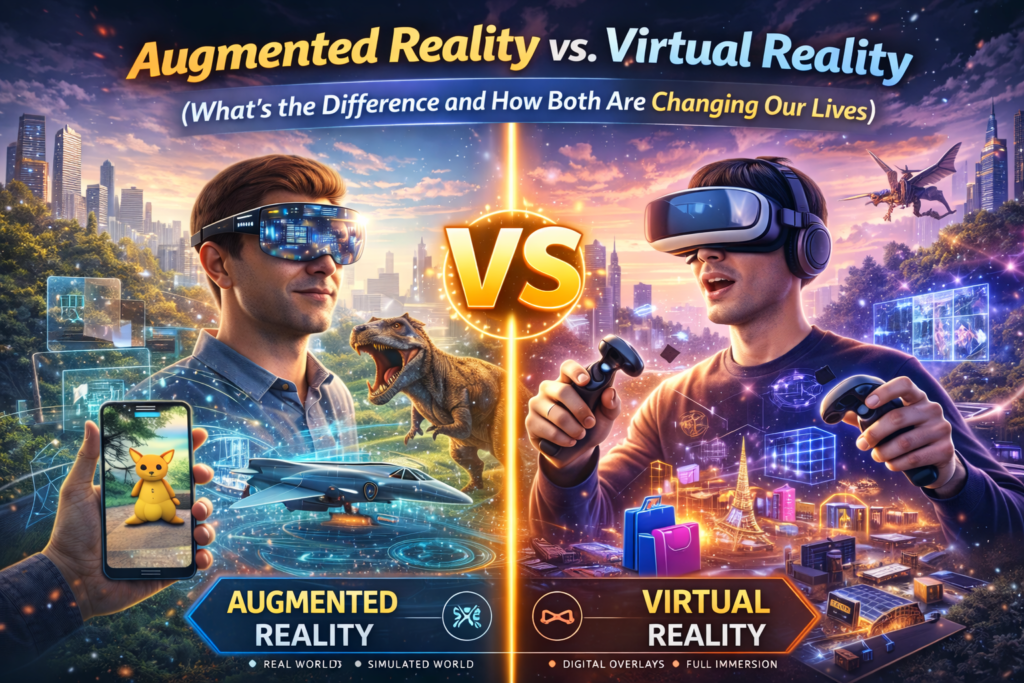
Augmented reality and virtual reality are often confused but they have distinct differences. While both are immersive technologies the key difference lies in how they interact with the real world.
Augmented Reality enhances the real world by overlaying virtual objects onto it. You can still see and interact with your physical environment while using AR. For example when using an AR app like Pokémon Go the virtual Pokémon appears on your screen but you are still aware of your surroundings.
Virtual Reality (VR) on the other hand creates a completely virtual environment shutting out the real world entirely. VR requires a headset that immerses the user in a 360 degree virtual environment. VR is primarily used for gaming and simulations.
Practical AR Applications: How Augmented Reality Is Used in Everyday Life
Augmented reality is already a part of everyday life in many ways. From gaming to shopping AR enhances how we interact with the world.
- In Retail: Augmented reality applications like the IKEA Place app allow users to visualize how furniture will look in their homes before making a purchase. This is just one example of how AR works to enhance the shopping experience.
- In Education: AR is changing the way students learn. For example augmented reality in education allows for interactive learning where students can engage with virtual objects and models making abstract concepts easier to understand.
- In Gaming: Augmented reality games like Pokémon Go have proven the power of AR in entertainment blending digital content with the real world to create an interactive experience.
- In Healthcare: AR is also making waves in healthcare where it is used for everything from surgical planning to medical training allowing healthcare professionals to visualize patient data in real time.
Augmented Reality in Education (How AR Will Revolutionize Learning in 2026)
By 2026 augmented reality in education will be more advanced providing immersive and interactive learning experiences. Students will be able to interact with 3D models of the human body explore historical events or practice scientific experiments without ever leaving the classroom.
In addition augmented reality applications will enable remote learning with AR enhanced lectures virtual field trips and interactive lessons. With AR technology becoming more accessible the learning experience will be transformed making education more engaging and effective for students around the world.
Comparison Table: AR vs VR
| Feature | Augmented Reality (AR) | Virtual Reality (VR) |
| User Experience | Blends virtual and real world elements | Fully immersive virtual only experience |
| Devices | Smartphones tablets smart glasses | VR headsets |
| Interactivity | Real world environment interaction | Completely virtual environment |
| Popular Applications | Retail education gaming healthcare | Gaming simulations training |
| Technology | Overlay of digital objects onto reality | Total immersion in a computer-generated world |
Conclusion: Augmented Reality in 2026. The Future is Now
In conclusion augmented reality is set to revolutionize the way we interact with the world. From its immersive experiences in gaming and education to its practical applications in retail and healthcare AR is becoming an integral part of our daily lives. As we look ahead to 2025 the potential for AR is immense with advancements in augmented reality technology and new use cases emerging every day. As AR continues to evolve it will become even more immersive interactive and accessible. Whether you are using AR devices enjoying augmented reality experiences or exploring innovative applications the future of AR promises to be an exciting and transformative journey.
What is augmented reality (AR)?
Augmented reality (AR) overlays digital content such as images sounds or text onto the real world environment. It enhances your perception of the world by adding virtual elements that you can interact with in real time.
How does augmented reality work?
AR works by using cameras sensors and software to detect your surroundings then it projects virtual objects onto the real world. It requires a device like a smartphone AR glasses or an AR headset to interact with the virtual content.
How is augmented reality different from virtual reality (VR)?
The main difference is that AR adds virtual elements to the real world while VR creates an entirely virtual environment. AR enhances reality and VR immerses you in a completely new digital world.
What are some real world examples of augmented reality?
Examples of AR include apps like IKEA Place where you can see how furniture fits into your home Pokémon Go which overlays digital characters into your surroundings and AR learning apps that bring educational content to life.
Can AR be used on smartphones?
Yes AR works on smartphones through apps that use your phone’s camera and sensors to display virtual content in the real world. Popular AR apps include games like Pokémon Go shopping apps like IKEA Place and educational tools.